
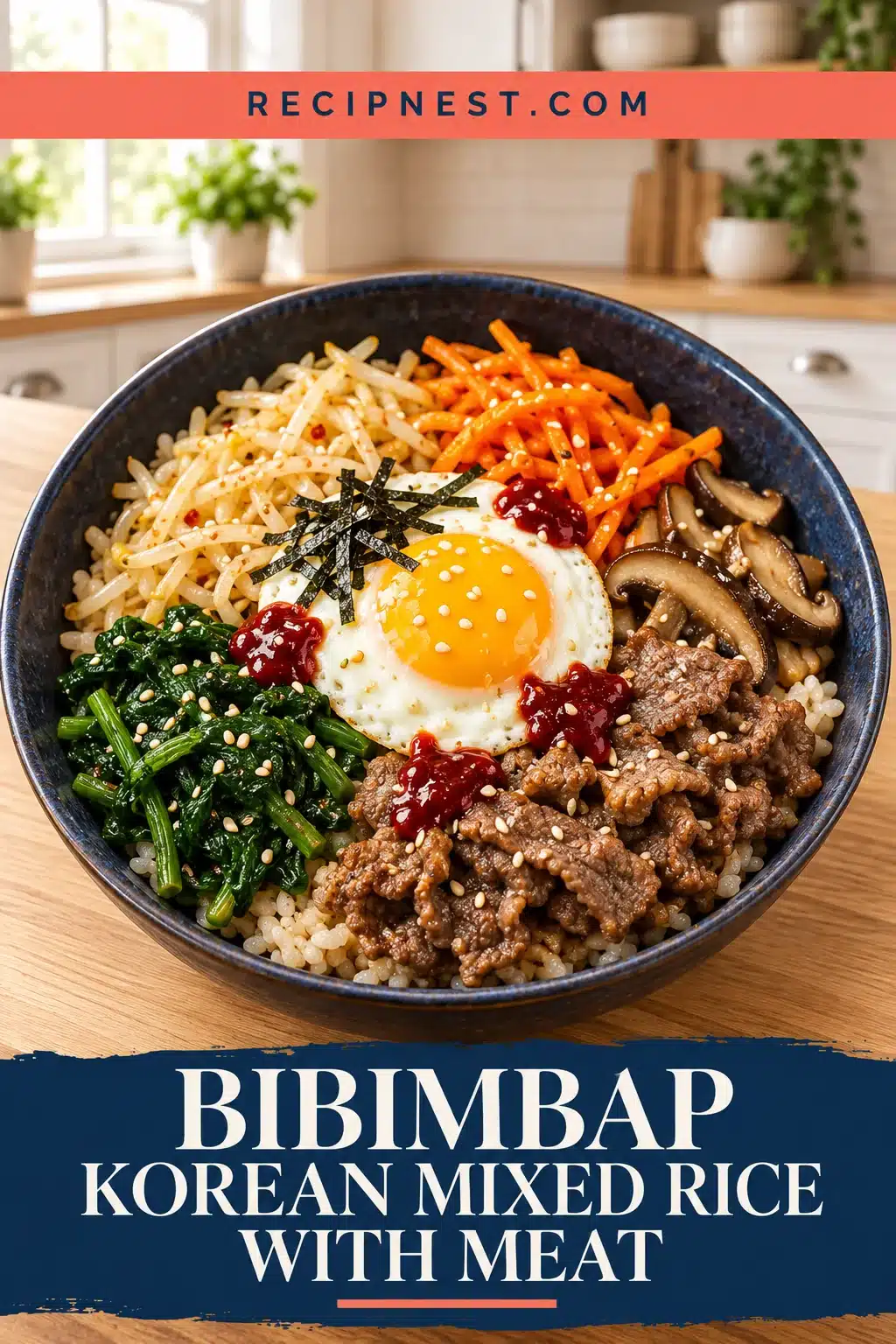
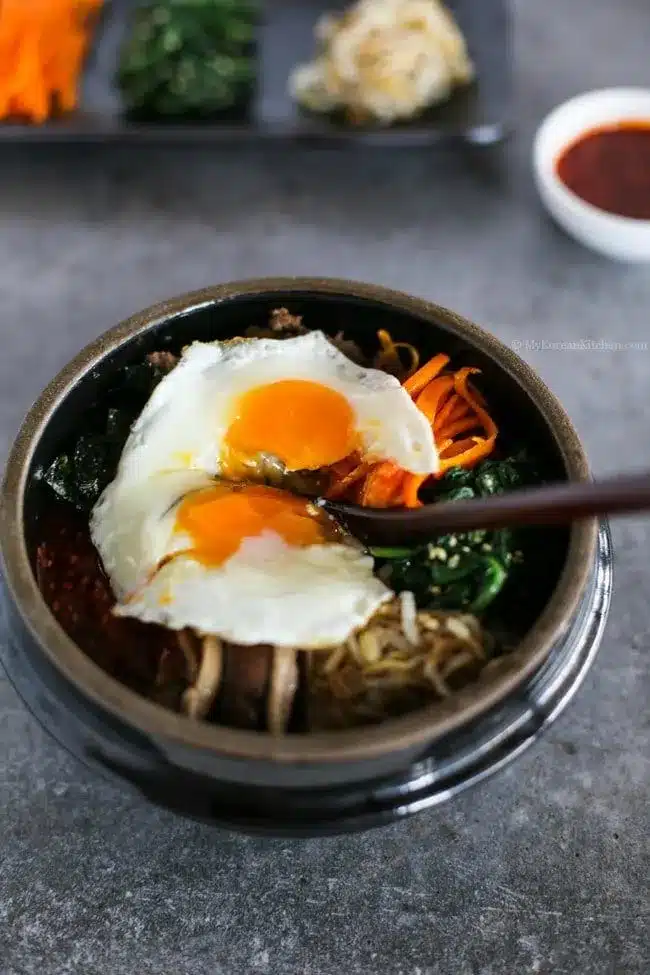
This Bibimbap (Korean Mixed Rice with Meat and Assorted Vegetables) is a colorful Korean rice bowl made with seasoned beef, fresh vegetables, shiitake mushrooms, a fried egg, and a delicious homemade gochujang sauce. With a combination of savory, spicy, and slightly sweet flavors, this satisfying dish brings the comfort of Korean cooking to your kitchen.
Bibimbap is a popular Korean dish that combines warm rice, seasoned proteins, fresh vegetables, and a flavorful sauce in one bowl. The ingredients are arranged separately before being mixed together just before eating.
This homemade Bibimbap recipe serves approximately 3 to 4 people and can be adapted with different vegetables, proteins, and toppings. It also makes a practical way to use leftover cooked vegetables and rice when they have been stored safely.
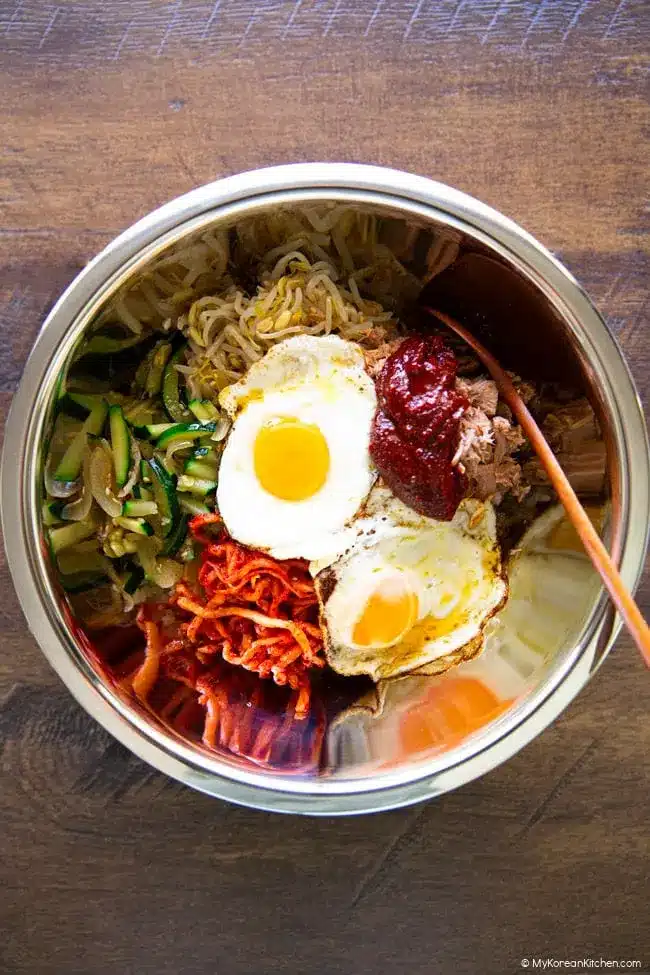
Table of Contents
What Is Bibimbap?
Bibimbap is a traditional Korean dish whose name means “mixed rice.” It typically combines cooked rice with assorted vegetables, a protein such as beef, an egg, and a spicy sauce.
The name reflects the way the dish is eaten: the toppings and rice are mixed together so that every bite contains a combination of flavors and textures.
This flexible dish allows you to change the vegetables, adjust the level of spice, and select the protein that works best for your meal.
There are several variations of bibimbap, including dolsot bibimbap, which is served in a hot stone bowl, and yangpun bibimbap, which is commonly mixed in a large bowl.
You can prepare bibimbap with meat and assorted vegetables. You can also make a vegetarian version using tofu, mushrooms, and seasoned vegetables.
In Korean home cooking, bibimbap is also a convenient way to combine prepared vegetable side dishes, known as banchan, with rice, sesame oil, and gochujang.
For a satisfying vegetarian option, replace the beef with additional vegetables, tofu, or mushrooms.
Bibimbap is especially convenient when you have previously cooked vegetables that are still safe to eat. Properly stored vegetables can be reheated and added to the bowl, rather than allowing them to become less fresh) or when preparing every topping from scratch is not practical.
Although many restaurants serve beautifully presented bibimbap, like the colorful bowls often shown in photographs, everyday homemade versions can be just as delicious.
Why You’ll Love This Bibimbap Recipe
This homemade Korean mixed rice bowl is flavorful, flexible, and filling. It combines several ingredients in one complete meal.
- Balanced flavors: Savory beef, seasoned vegetables, sesame oil, and spicy gochujang complement one another.
- Colorful presentation: Carrots, spinach, sprouts, mushrooms, and a fried egg create a visually appealing bowl.
- Customizable: You can change the vegetables, protein, and sauce quantity.
- Convenient meal preparation: Several components can be prepared in advance and assembled before serving.
- Adjustable spice level: Use more or less bibimbap sauce according to your preferences.
- Perfect for family meals: Each person can choose the toppings they enjoy.
Ingredients for Bibimbap (Serves 3 to 4)
The recipe consists of seasoned beef, cooked vegetables, steamed rice, fried eggs, and a homemade gochujang sauce.
Meat and Meat Sauce
- 100 g / 3.5 oz ground beef, or another suitable beef cut
- 1 tablespoon soy sauce
- 1 tablespoon sesame oil
- 1 teaspoon brown sugar
- 1/4 teaspoon minced garlic
The soy sauce, sesame oil, brown sugar, and garlic create a simple marinade for the beef.
Allow the beef to marinate for approximately 30 minutes while preparing the other ingredients.
Vegetables and Other Ingredients
- 250 g / approximately 0.6 lb seasoned spinach
- 350 g / approximately 0.8 lb seasoned bean sprouts
- 100 g / 3.5 oz shiitake mushrooms
- 120 g / 4.2 oz carrots, approximately 1 small carrot
- 1/2 teaspoon fine sea salt, divided between the mushrooms and carrots
- 3 to 4 serving portions of steamed rice
- 3 or 4 eggs, depending on the number of servings
- Cooking oil, as needed for the beef, mushrooms, carrots, and eggs
- Toasted seasoned seaweed, shredded into thin strips
The original recipe uses generous quantities of seasoned spinach and bean sprouts. You can use less if you prefer a smaller vegetable portion.
Homemade Bibimbap Sauce
- 2 tablespoons gochujang
- 1 tablespoon sesame oil
- 1 tablespoon sugar
- 1 tablespoon water
- 1 tablespoon toasted sesame seeds
- 1 teaspoon vinegar, such as apple cider vinegar
- 1 teaspoon minced garlic
Gochujang is a Korean fermented red chili paste that gives bibimbap sauce its characteristic spicy, savory flavor.
The sauce quantity is generally enough for approximately 3 servings when used generously. Prepare extra if serving four people who enjoy plenty of sauce.
How to Make Bibimbap
Making homemade bibimbap involves preparing the rice, cooking the meat and vegetables separately, mixing the sauce, and assembling everything in a bowl.
Step 1: Marinate the Beef
In a small bowl, combine the soy sauce, sesame oil, brown sugar, and minced garlic.
Add the ground beef and mix until coated.
Let the beef marinate for approximately 30 minutes while you prepare the vegetables and rice.
Step 2: Prepare the Bibimbap Sauce
Combine the gochujang, sesame oil, sugar, water, toasted sesame seeds, vinegar, and minced garlic in a bowl.
Stir until the sauce becomes smooth and the sugar is evenly distributed.
Set the sauce aside until you are ready to assemble the rice bowls.
Step 3: Cook the Beef
Heat a little cooking oil in a wok or large skillet over medium-high to high heat.
Add the marinated beef and cook for approximately 3 to 5 minutes, breaking it apart as necessary.
Continue cooking until the ground beef is fully cooked and reaches an internal temperature of 160°F (71°C).
For an additional ground beef preparation, you can also mix the beef with other seasonings according to the recipe you are preparing.
Step 4: Prepare the Spinach and Bean Sprouts
Prepare the spinach and bean sprouts using your preferred Korean seasoned vegetable recipes.
The original bibimbap recipe calls for seasoned spinach and seasoned bean sprouts rather than plain raw vegetables.
Drain any excess liquid before assembling the rice bowls to prevent the rice from becoming watery.
Step 5: Cook the Carrots
Rinse, peel, and julienne the carrots into thin strips.
Heat a small amount of cooking oil in a wok or skillet.
Add the carrots and 1/4 teaspoon fine sea salt.
Cook over medium-high to high heat for approximately 2 to 3 minutes until slightly softened.
Step 6: Cook the Shiitake Mushrooms
Clean the shiitake mushrooms and slice them thinly.
Heat a little cooking oil in a skillet and add the mushrooms with the remaining 1/4 teaspoon of salt.
Cook for approximately 2 to 3 minutes, or until the mushrooms are tender and cooked through.
Step 7: Cook the Eggs
Prepare one fried egg per serving.
Sunny-side-up eggs are a common bibimbap topping, but you can cook the eggs to your preferred doneness.
For fully cooked eggs, cook until both the whites and yolks are firm.
Step 8: Assemble the Bibimbap Bowls
Divide the steamed rice among three or four serving bowls.
Arrange the cooked beef, spinach, bean sprouts, carrots, mushrooms, and seaweed over the rice.
Add a fried egg to the center of each bowl.
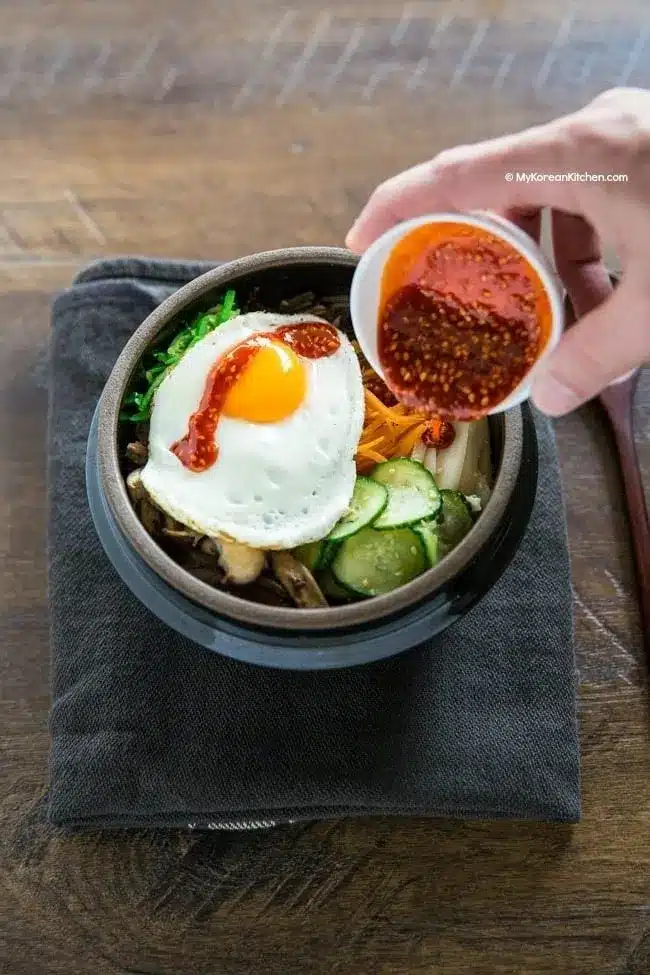
Step 9: Add the Sauce and Mix
Spoon the homemade gochujang sauce over the ingredients according to your preferred spice level.
Mix the rice, beef, vegetables, egg, and sauce together thoroughly before eating.
For general information about building balanced meals, explore the Academy of Nutrition and Dietetics.
Bibimbap Recipe Success Tips
Prepare the Ingredients Before Cooking
Bibimbap involves several individual components, so washing, chopping, and measuring the vegetables before cooking can make the process easier.
Cook the Vegetables Separately
Cooking the carrots, mushrooms, spinach, and bean sprouts separately helps preserve their individual flavors and textures.
Use Freshly Cooked Rice
Warm steamed rice makes an excellent base for bibimbap because it mixes easily with the vegetables and sauce.
If using leftover rice, refrigerate it promptly after cooking and reheat it thoroughly before serving.
Adjust the Gochujang Sauce
Gochujang brands vary in heat and sweetness. Start with a smaller amount of sauce and add more after tasting.
Avoid Overcooking the Vegetables
Carrots and mushrooms need only a few minutes of cooking in the original recipe.
Keep the vegetables tender while retaining some texture.
Prepare Components Ahead of Time
The meat marinade, sauce, and several cooked vegetables can be prepared in advance and refrigerated appropriately.
Assemble the bowls just before serving for the freshest texture.
Bibimbap Substitutions and Variations
Vegetarian Bibimbap
Omit the beef and increase the amount of mushrooms, tofu, or vegetables.
Use a vegetarian-friendly sauce and check the ingredients of any prepared seasonings.
Chicken Bibimbap
Substitute cooked, seasoned chicken for the ground beef.
For another chicken-based family dinner, explore our Slow Cooker Santa Fe Chicken.
Mushroom Bibimbap
Increase the shiitake mushrooms or add other suitable mushrooms for a vegetable-focused bowl.
Less Spicy Bibimbap
Use less gochujang sauce and serve additional sauce separately so everyone can adjust the spice level.
Dolsot Bibimbap
Dolsot bibimbap is served in a heated stone bowl, which can create a crisp layer of rice along the bottom.
Use cookware specifically designed for this method and follow its heating instructions.
Additional Vegetable Options
You can also use daikon radish salad, Korean cucumber salad, seasoned greens, gosari, or bellflower root.
Choose vegetables that complement the sauce and rice without releasing too much liquid.
What to Serve with Bibimbap
Bibimbap is already a substantial meal because it contains rice, beef, vegetables, and eggs. However, Korean-style side dishes can make the meal even more enjoyable.
Kimchi
Kimchi provides a tangy, spicy contrast to the savory rice bowl.
Korean Cucumber Salad
A fresh cucumber salad adds crunch and a refreshing contrast to the warm rice and beef.
Seasoned Bean Sprouts
Extra seasoned bean sprouts can be served on the side for anyone who wants more vegetables.
Seasoned Spinach
Korean-style seasoned spinach adds another mild vegetable side that pairs naturally with bibimbap.
More Easy Dinner Ideas
For a different satisfying dinner featuring protein and vegetables, try our Chicken Sausage White Bean Skillet.
You can also explore our Loaded Hummus Pitas for another vegetable-filled meal idea.
How to Store and Reheat Bibimbap
Refrigerating Leftovers
Store cooked beef, vegetables, and rice in airtight containers in the refrigerator.
Refrigerate promptly and use within approximately 3 to 4 days when properly stored.
Store the Sauce Separately
Keep leftover bibimbap sauce in a separate covered container in the refrigerator.
Mix the sauce into the rice bowl just before serving for the best texture.
Reheating Bibimbap
Reheat the cooked rice, meat, and vegetables thoroughly before serving.
Add a freshly cooked egg and the sauce after reheating if desired.
Can You Freeze Bibimbap?
Cooked rice and beef can be frozen in appropriately sealed containers.
For the best texture, prepare fresh vegetable toppings and eggs when serving rather than freezing the fully assembled bowl.
Bibimbap – Korean Mixed Rice with Meat and Assorted Vegetables Recipe
This homemade Bibimbap recipe makes approximately 3 to 4 servings.
Ingredients
Meat and Meat Sauce
- 100 g ground beef (3.5 oz)
- 1 tablespoon soy sauce
- 1 tablespoon sesame oil
- 1 teaspoon brown sugar
- 1/4 teaspoon minced garlic
Vegetables and Other Ingredients
- 250 g seasoned spinach
- 350 g seasoned bean sprouts
- 100 g shiitake mushrooms
- 120 g carrots
- 1/2 teaspoon fine sea salt, divided
- 3 cups steamed rice, approximately 3 to 4 serving portions
- 3 eggs, or 4 if making four servings
- Cooking oil as needed
- Toasted seasoned seaweed, shredded
Bibimbap Sauce
- 2 tablespoons gochujang
- 1 tablespoon sesame oil
- 1 tablespoon sugar
- 1 tablespoon water
- 1 tablespoon toasted sesame seeds
- 1 teaspoon vinegar
- 1 teaspoon minced garlic
Instructions
- Mix the ground beef with soy sauce, sesame oil, brown sugar, and minced garlic. Marinate for approximately 30 minutes.
- Combine all bibimbap sauce ingredients in a bowl and stir until smooth.
- Prepare the seasoned spinach and bean sprouts.
- Julienne the carrots and cook them in a little oil with 1/4 teaspoon salt for approximately 2 to 3 minutes.
- Slice the shiitake mushrooms and cook with the remaining 1/4 teaspoon salt for approximately 2 to 3 minutes.
- Cook the marinated beef in a lightly oiled skillet for approximately 3 to 5 minutes, or until fully cooked to 160°F (71°C).
- Prepare 3 or 4 fried eggs according to the number of servings.
- Divide the steamed rice among serving bowls.
- Arrange the cooked beef, spinach, bean sprouts, carrots, mushrooms, and shredded seaweed over the rice.
- Add one fried egg to each bowl.
- Spoon the bibimbap sauce over the toppings.
- Mix all the ingredients together before eating.
Recipe Notes
- Other vegetable options include daikon radish salad, Korean cucumber salad, gosari, and bellflower root.
- Adjust the gochujang sauce quantity according to your preferred spice level.
- Use freshly cooked or properly reheated rice.
- One tablespoon equals 15 ml.
- For four servings, prepare four eggs if you want one egg per person.
Nutrition Information
Nutrition values vary depending on the rice portions, vegetables, protein, and amount of sauce used. Any calculated nutrition figures should be treated as estimates.
Frequently Asked Questions
What Is Bibimbap Made Of?
Bibimbap typically includes steamed rice, seasoned vegetables, a protein such as beef, an egg, and a spicy gochujang-based sauce.
What Does Bibimbap Mean?
Bibimbap means “mixed rice” in Korean, referring to the way the rice and toppings are mixed together before eating.
Is Bibimbap Served Hot or Cold?
Bibimbap is commonly served with warm rice and cooked toppings. Some vegetables may be served at room temperature, depending on the preparation.
Do You Mix Bibimbap Before Eating?
Yes. Mix the rice, vegetables, beef, egg, and sauce together so the flavors are distributed throughout the bowl.
Is Bibimbap Spicy?
Bibimbap can be spicy because the sauce contains gochujang. You can adjust the heat by adding less sauce.
Can I Make Bibimbap Without Meat?
Yes. Replace the beef with tofu, mushrooms, or additional vegetables for a vegetarian variation.
What Rice Is Best for Bibimbap?
Steamed short- or medium-grain rice works especially well because it holds together nicely when mixed with the toppings.
What Is Gochujang?
Gochujang is a Korean fermented chili paste with spicy, savory, and slightly sweet flavors. It is commonly used in bibimbap sauce.
Can I Prepare Bibimbap Ahead of Time?
Yes. Prepare the beef, vegetables, and sauce ahead and store them safely in the refrigerator. Assemble the bowls when ready to serve.
Can I Use Other Vegetables in Bibimbap?
Yes. Zucchini, cucumber, daikon radish, leafy greens, mushrooms, and other suitable vegetables can be used.
Can I Use Chicken Instead of Beef?
Yes. Fully cooked, seasoned chicken can replace ground beef. Cook poultry to an internal temperature of 165°F (74°C).
How Long Does Leftover Bibimbap Last?
When properly refrigerated, cooked ingredients can generally be stored for approximately 3 to 4 days. Reheat the meat and rice thoroughly before serving.
Bibimbap – Korean Mixed Rice with Meat and Assorted Vegetables

Learn how to create authentic Korean Bibimbap, a vibrant and wholesome dish bursting with flavors. Complete with a bibimbap sauce that’s so good, you’ll want to drizzle it on everything!
- Prep Time: 35 mins
- Cook Time: 55 mins
- Total Time: 90 mins
- Yield: 3, 3 to 4 1x
- Method: Main
- Cuisine: Korean
Ingredients
- 100 g beef mince ((3.5 ounces), (or other cuts))
- 1 Tbsp soy sauce
- 1 Tbsp sesame oil
- 1 tsp brown sugar
- 1/4 tsp minced garlic
- 250 g spinach ((0.6 pounds))
- 350 g bean sprouts
- 100 g shiitake mushroom ((3.5 ounces))
- 120 g carrots ((4.2 ounces, 1 small))
- 1/2 tsp fine sea salt ((1/4 tsp each will be used when cooking shiitake mushroom and carrots))
- 3 cups steamed rice ((3 to 4 serving portions ))
- 3 eggs ((3 or 4 depending on the serving portion))
- Some cooking oil ((to cook the meat, mushroom, carrots and eggs – I used rice bran oil))
- Some toasted seasoned seaweed (shredded (long thin cut))
- 2 Tbsp gochujang
- 1 Tbsp sesame oil
- 1 Tbsp sugar (- I used raw sugar)
- 1 Tbsp water
- 1 Tbsp toasted sesame seeds
- 1 tsp vinegar (- I used apple vinegar)
- 1 tsp minced garlic
Instructions
- Prepare and cook ingredients as below. – For meat, mix the beef mince with the meat sauce listed above. Marinate the meat for about 30 mins while you are working on other ingredients to enhance the flavour. Add some cooking oil into a wok and cook the meat on medium high to high heat. It takes about 3 to 5 mins to thoroughly cook it.- Mix the bibimbap sauce ingredients in a bowl.- Cook spinach and bean sprouts per linked recipe.- Rinse, peel and julienne the carrots. Add some cooking oil and 1/4 tsp of fine sea salt in a wok and cook the carrots on medium high to high heat for 2 to 3 mins.- Clean/rinse the shiitake mushrooms and thinly slice them. Add some cooking oil and 1/4 tsp of fine sea salt in a wok and cook the mushrooms on medium high to high heat until they are all cooked. (It takes 2 to 3 mins.)- Make fried eggs. (While sunny side up is common, you can make them per your preference.)
- Put the rice into a bowl and add the meat, assorted vegetables, seasoned seaweed, bibimbap sauce, and the egg on top of the rice. Serve.
- To eat, mix the ingredients in the bowl, and enjoy!
Nutrition
- Calories: 570 kcal
- Sugar: 14 g
- Sodium: 916 mg
- Fat: 23 g
- Saturated Fat: 6 g
- Carbohydrates: 71 g
- Fiber: 7 g
- Protein: 24 g
- Cholesterol: 187 mg